Zondervan NIV Study Bible, Indexed Review
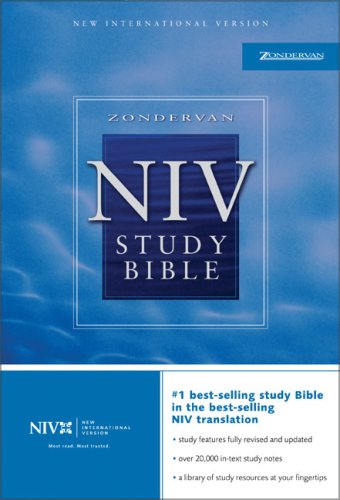
I ordered this bible because I had the same bible but not hardbound and it was falling apart. The bible is excellent.
Zondervan NIV Study Bible, Indexed Overview
#1 Best-selling study Bible in the best-selling NIV translation
Study features fully revised and updated. Over 20,000 in-text study notes. A library of study resources at your fingertips.
Available at Amazon Check Price Now!
Related Products
- NIV Compact Thinline Bible
- Bible Cover: Distressed Leather-Look Brown with Stitching Accent Med
- Zondervan NIV Study Bible: Updated Edition
- Zondervan NIV Study Bible (New International Version)
- Zondervan NIV Study Bible
Customer Reviews
A Very Weak Study Bible - L. Jackson - Oregon, USA
While I am not a fan of the NIV translation for a variety of reasons, I purchased this Study Bible simply for the commentary and study notes. I have many Study Bibles that I frequently use and cross reference, and this is by far the least useful of them all. Many of the "notes" are simply references to other verses and passages, which is an important component in a Study Bible, but for many passages that is the only "note" included. If I simply wanted cross-references, I would have purchased a reference Bible, like a Thompson Chain-Reference Bible. When there is commentary on a passage, it's usually very watered down, and does little to clarify the meaning of the passage.
For a much better Study Bible, I would recommend any of the following
The NKJV Study Bible: Second Edition
The ESV Study Bible
NASB MacArthur Study Bible
All of these are full of very helpful and insightful interpretive and background notes on the text. You'll walk away with a far greater understanding of Scripture than with the NIV Study Bible. Don't waste your money on this. The only purpose I have for this "Study Bible" is not for the notes at all, but for teaching Sunday School for the High School students at my church, as most of them use the NIV, and it's my only copy of the translation. Even then I usually read verses from the passage I'm teaching in a better translation like the NASB, NKJV, ESV, or HCSB.
Stop and read before you buy this Bible - Timothy Blackburn - Glen Allen, VA United States
Stop and read before you purchase this book.
Many people are amazed when I tell them our family doesn't use the NIV. They immediately assume I am associated with KJV-onlyism. While I respect the grand old translation, I am not opposed to modern versions that remain true to the original text nor do I believe translations have to be stilted. In fact, I often use good modern versions for our family and personal devotions. First, I need to explain some background foundational to my position.
The differences between versions are 1) textual or the source original text and 2) translational or the philosophy of translation. I'll not argue a position on textual differences in this paper (which accounts for no more than about 8% of the differences between versions but most of the debate and division between Christians). My issue with the NIV is primarily translational. Faithful to the original versions such as the NKJV, KJV, NASB, and ESV follow a Formal Equivalence philosophy of translation, changing wording when there is a grammatical/syntax necessity. You will see many of these versions put added words in italics, while it is impossible to do so given the degree of change in the NIV.
Versions such as the NIV follow the Dynamic Equivalence form of translation, which take liberties by adding wording or phrases for non-syntax reasons and to explain versus translate the original text where the translators feel it won't be understood (whether or not the original was easily understood). Paraphrases, such as The Message, NLT, etc. completely rewrite Scripture in an interpretive sense. The NIV is somewhere between a Paraphrase and Formal Equivalent translation. Let me explain the results of an analysis I performed:
Based on a sampling of OT/NT NIV text and comparing to the original languages, I found seven Formal Equivalence versions combined took liberties (usually for syntax reasons) in only about 6% of the verses, while the NIV took liberties in 64% of the verses sampled. These were not different word choices for translation, but alterations based on what was perceived to be the thought of the author rather than the words. So, when I read the NIV, I am getting one or more of the translators' interpretation of the meaning versus the original text in about two-thirds of the verses. Dr. Martin summed up the situation well when he wrote, "The dynamic equivalence translator tends to be relatively unrestrained in his theologizing. What a formal equivalence translator generally does only as a matter of necessity, the dynamic equivalence translator often does as a matter of choice."
While I most often agree with the interpretation (although not the translation) of the NIV translators in that they generally held conservative theological views, I strongly disagree that rewriting Scripture is acceptable even to express a conservative position. If I want a commentary I'll read one. I suspect many NIV proponents would be appalled if the original Greek, Hebrew, or Aramaic were edited to improve clarity, but find it completely acceptable to do so as part of translation. The doctrine of inerrancy should also mean we are to translate accurately.
Arguments for using the NIV due to readability are not convincing to me, given there are several good readable and faithful modern versions, and I believe the Bible was hard to understand even in the first century (e.g. Peter noted that Paul's writings were hard to understand.) It is a spiritually discerned Book. While the Bible was written in common languages and there should be no attempt to make something confusing that is meant to be clear, deeper theological concepts were not easily understood. The argument that the meaning must be simplified to be understood or "explained" is similar to the arguments made before the Reformation not to translate the Bible to English - I often refer to translators and vocal proponents of such translations as the NIV as the "new priesthood."
I acknowledge the version each person uses must ultimately be between him/her and God, and I fellowship with many people who use the NIV, viewing them as brothers/sisters in Christ and Godly people. I used it for many years myself before studying the subject in depth. Unfortunately, most good-intended pastors have little if any instruction from our seminaries in Textual Criticism/translational philosophy and are completely ill equipped to treat the issue of Bible versions with their flock.
I'm not looking to enter into a debate - I am quite resolute in my convictions, prayerfully founded on solid research. Confirm what I am saying is true. Even the early Christians checked the Scriptures to check the Apostles' accuracy. You'll need to decide for yourself but I recommend you prayerfully research the matter from reliable sources, the best one being the Bible. For example, purchase or borrow an interlinear Greek/English New Testament. In it you will find the Greek wording with literal English words beneath. Select 30 verses (a generally accepted good sample size). Compare it to the NIV and any of the common Formal Equivalent translations (KJV, NKJV, NASB, ESV) and count the number of verses that add to or take away (or rephrase) God's Word. You don't need to know Greek to quickly see what I am writing is true. You will also see that it was not necessary to rewrite the text to be able to comprehend what was written.
Regarding research, an excellent and readable book (quoted from previously) that I recommend on the subject that is not extreme and reflects my position is "Accuracy of Translation: The Primary Criterion in Evaluating Bible Versions With Special Reference to the New International Version" by Robert P. Martin and available on Amazon for about . I recommend avoiding KJV-onlyism books, pro or con, which are long on opinion with spurious arguments but short on academic integrity, honesty, and depth.
So far in this paper, I have approached the NIV-problem technically. But there are also real-life practical experiences that steer me clear of Dynamic Equivalents and Paraphrases. While using the NIV, I eventually began to question whether the NIV was a good translation when it occurred to me it didn't match what I heard growing up, and I had a sense the original language wasn't that simplified. Later, I heard an otherwise respected preacher deliver an entire sermon based on a word found in a verse from the NIV. While reading along in my NASB, I realized the word wasn't even there - the translators added it. Later at home, I confirmed this by reviewing the original Greek.
But even more convincing are my elementary school children. At their Christian school teachers or ministers at chapel occasionally read from the NIV or paraphrases. All three children have come home and noted that what was read wasn't correct, and were appalled (from their perspective) that someone would take the Bible so lightly.
We know from the Bible that even the shapes of letters are important. What my little ones memorize can stick with them the rest of their lives, stored in their hearts that they might not sin against God. I want them to memorize the Words of God accurately reflective of the original - the NIV does not do that . . .
In closing, ask yourself an important question. If you believe the Bible contains the inspired, inerrant, and infallible Word of God, what does that mean? Does it mean the very words penned are important, or the thoughts some scholar interprets for you?
Kindle version NOT same as real study Bible - -
The notes that are on every page of the paper study Bible are nowhere tobe found in the Kindle version. There are other study helps but some awkward to access. The verse by verse comments, on the same page as the Bible text, are what I really wanted, but could not find.
*** Product Information and Prices Stored: Aug 29, 2010 16:49:04

No comments:
Post a Comment