Letter to a Christian Nation (Vintage) Review
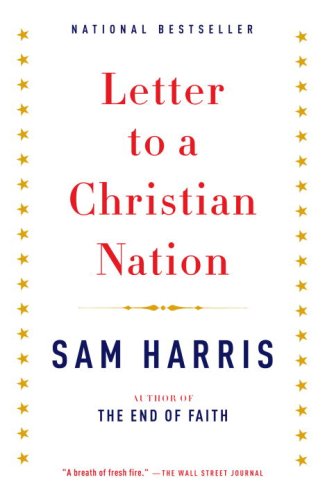
This condenses neo-atheist arguments efficiently if briskly. It sums up secular humanism. It prefaces longer works by Richard Dawkins, Christopher Hitchens, and Daniel Dennett. It's a pithy, barbed attack.
I've reviewed on Amazon, alongside with hundreds or thousands of bickering peers, "The God Delusion," "god Is Not Great," and "Breaking the Spell"-- as well as "The End of Faith." (See my review back in mid-Oct. 2004). Compared to "End," I preferred Harris' 2006 riposte. Yet, it seems a lost cause no matter if you agree or disagree, given the polemical stances most critics assume. However, I tried to read this as fairly and objectively as possible. For comparison, I've also reviewed works such as Dean Hamer's "The God Gene" and Francis Collins' "The Language of God."
Given less than a hundred small pages in large print, this response to Harris' outraged Christian readers cannot equal the scientific depth of Dennett, the cultural critique of Hitchens, and the magisterial tone of Dawkins. Instead, a rapid paraphrase of opposing views to his compressed assertions suffices. This review cannot address the immense philosophical arguments or the geo-political ramifications of the neo-atheist agenda. Instead, I will cite his main points. Judge if this book merits your attention.
He repeats Dawkins' complaint that liberal believers "lend tacit support to the religious divisions in our world." (ix) He thinks progressive adherents lend comfort as it were to the "divisive, injurious, retrograde" versions of Christianity, for instance. However, he grants that liberals and moderates "can recognize a common cause" with unbelievers as they confront extremists and fundamentalists. (x)
Belittling literalists: "If we take Jesus in half his moods, we can easily justify the actions of St. Francis of Assisi" - His other half justifies the Inquisition. (14) Yet, Harris acknowledges that such sacrificial self-denial for the greater good may be admirable. It's only that one need not be a believer in the virgin birth or that Jesus "will be returning to earth as a superhero to take those teachings to heart." (25) For those who condemn enemies of organized religion as atheist monsters--Hitlers, Stalins, Pol Pots--Harris coolly stresses how their problem is not that they "reject the dogma of religion," but that these tyrants "embrace other life-destroying myths." (41) Not extreme rationalism but unfettered "political and racial dogmatism" can be blamed for this totalitarianism. As with religious intolerance, it's rooted in dogma.
Intriguingly, he finds red states in their religious and social conservatism in worse shape as to crime; 50 nations lowest in the UN's "human development index" he concludes "are unwaveringly religious." (44) Harris claims that atheist societies in advanced economies devote far more to charitable aid and social welfare programs. They also have far lower rates of CEO vs. worker income disparity: compare 13:1 in Sweden to 475:1 in the U.S. Teen pregnancy rates in the U.S are four-five times that of other advanced nations even as the U.S. proclaims far higher levels of devotion to Jesus.
"Atheism is nothing more than the noises reasonable people make in the presence of unjustified religious beliefs." (51) No more than Zeus or Poseidon, Harris regards God or Allah. "An atheist is a person who believes that the murder of a single little girl--even once in a million years--casts doubt upon the idea of a benevolent God." (52) Due to doubt, nonbelievers who question taboos, hatreds, wars, even "diversion of scarce resources"--all the suffering attributed to religious fanaticism-- get relegated to the margins: compared to "the fantasy life" of one's "neighbors." (57) "Religion is the one area of our lives where people imagine that some other standard of intellectual integrity applies." (65)
He neatly inverts the arguments used by Christians against atheists to ask why Christians are not convinced by Islam. "Understand that the way you view Islam is precisely the way devout Muslims view Christianity. And it is the way I view all religions." (7) Conflating the claims of damnation sallied by Muslims with those of Christians, he warns how elusive will be the hopes of interfaith dialogue among pacified People of the Book. Millions will ally to die fighting against Christians before "they would allow your version of compassion to gain a foothold on the Arabian Peninsula." (86) We don't worship the same God in the same way, he chides; ask the Shi'a about the Sunni.
Raising children as Jews, Muslims, or Christians, he complains, is a "ludicrous obscenity." He repeats, if more strongly worded, this protest from "End of Faith." I am not sure how Harris can persuade his opponents, but he articulates the defiant unbeliever who denies the confidence of the faithful. This charged language may inflame his foes further, but he matches their fire with his own. Whether this is the most successful approach to take may not matter. I find corroboration in his dismissal of interfaith dialogue and platitudes about reconciling "worldviews that are fundamentally incompatible and, in principle, immune to revision" (87). As with slavery, biblically sanctioned, he muses it may be a long struggle to convince irrational believers that scripture cannot trump morality to extend human rights.
Scientifically, Harris strives to dismantle, if hurriedly given the space allotted, the intelligent design proponents as well as creationists (the latter a Gallup poll tallies at 53% of the U.S. population). Of our plumbing that mixes our windpipe with our esophagus: "perhaps God has prepared a special reward in heaven for every child who chokes to death on a bottle cap." (79) For those less trusting in inscrutable ways of a Creator, Harris can only sigh: "How is it `moral' to think like this?"
Harris concludes: "This letter is the product of failure" for the attacks on religion that preceded it to bring about the death of God. (91) He wonders why the schools have not taught this message, why the media fails to criticize "the abject religious certainties of our public figures," and the despair over the social failures "great and small that have kept almost every society on this earth muddling over God and despising those who muddle differently." He cannot accept why Muslims chant "death to whole nations of the living" and how Christians deny "tangible reality, by the suffering you create in service to your religious myths, and by your attachment to an imaginary God."
I'm unconvinced Harris' vehemence will sway any Christian soldiers. His frustration shows. This may be more a handbook for those happy being preached to by the choir, but for that, Harris's return to the polemical arena may be a welcome harbinger of the long-delayed victory neo-atheists seek in their resurgence to win. He refuses to back down, and he seems to relish this combative stance. He tires of conciliation, and wearies of compromise--and here he matches those he resists, as in any epic battle.
Letter to a Christian Nation (Vintage) Feature
- ISBN13: 9780307278777
- Condition: New
- Notes: BUY WITH CONFIDENCE, Over one million books sold! 98% Positive feedback. Compare our books, prices and service to the competition. 100% Satisfaction Guaranteed
Letter to a Christian Nation (Vintage) Overview
From the new afterword by the author:
Humanity has had a long fascination with blood sacrifice. In fact, it has been by no means uncommon for a child to be born into this world only to be patiently and lovingly reared by religious maniacs, who believe that the best way to keep the sun on its course or to ensure a rich harvest is to lead him by tender hand into a field or to a mountaintop and bury, butcher, or burn him alive as offering to an invisible God. The notion that Jesus Christ died for our sins and that his death constitutes a successful propitiation of a “loving” God is a direct and undisguised inheritance of the superstitious bloodletting that has plagued bewildered people throughout history. . .
Available at Amazon Check Price Now!
Related Products
- The End of Faith: Religion, Terror, and the Future of Reason
- Breaking the Spell: Religion as a Natural Phenomenon
- God Is Not Great: How Religion Poisons Everything
- The God Delusion
- Letter to an Atheist Nation: Presupositional Apologetics Responds To: Letter to a Christian
Customer Reviews
Letter, Maybe a Rant, to a Christian Nation - R. Hutchinson - Silver Spring, MD USA
Sam Harris has a problem with Christians and particularly the Bible, and this book provides the venue for him to rant. However, Harris keeps getting distracted by the Muslims and the book ends up being a warning to non-Christians that the real problem is the Muslims and not Christians.
Nonetheless, Harris takes his shots at Christians (or their beliefs). He says that He "...has set out to demolish the intellectual and moral pretensions of Christianity..." He then asks a lot of questions and questions a lot of things but never addresses any alleged intellectual pretensions of Christianity other than to say that he doesn't like what Christians believe. As for morality, he has problems with abortion and homosexuality but misreads the Bible on slavery but he doesn't like slavery, so he has to say something.
The problem is that Harris never really investigates the problems that he sees. He doesn't like the way the Bible describes the origin of the universe and man. He then says that "Any intellectually honest person will admit that he does not know why the universe exists." The honest person knows that the universe cannot exist absent an explanation like that found in the Bible. He also says, "How the process of evolution got started is still a mystery..." The mystery is that life cannot spontaneously generate from non-life. But, he adds, "...that does not in the least suggest that a deity is likely to be lurking at the bottom of it all." So, without God, we need a miracle to start the process of evolution, but the source of the miracle cannot be God.
When discussing morality, Harris offers a list of things that give him problems. He says, "Consult the Bible, and you will discover that the creator of the universe clearly expects us to keep slaves." Obviously, God has a poor opinion of man but Harris wants to blame God for making man do this. Unfortunately, man needs no prompting from God and readily enslaves any and all within his power. Even a child soon learns that it is better to be the one giving orders than the one carrying out orders. Slavery seems the natural product of people who are noted for their selfishness and greed.
Harris says, "It is a scientific fact that moral emotions...preceded any exposure to Scripture." The reader quickly notices the lack of footnotes to statements like this. Elsewhere, he says, "It is clearly possible to say that someone like Hitler was wrong in moral terms without reference to scripture." People can say many things and express their personal morals, but how does one prove an absolute? Harris never gets to that point.
There are a few outlandish statements along the way. For example, we read, "It is safe to say that almost every person living in New Orleans at the moment Hurricane Katrina struck shared [the Christian's] belief in an omnipotent, omniscient, and compassionate God." Safe to say only if one does not have to offer evidence of what they say. In another case, we read, "In two places...the Good Book states that the ratio of the circumference of a circle to its diameter is 3:1." He then cites two Scriptures as proof suggesting that he either did not read the scriptures he cited or did not understand what he read.
In the end, if you enjoy reading books that rant about one thing or another but have nothing to offer that is better, this book is a good read. It has a lot of rants.
Pass it along.... - Prof Horn - Wolcott, CT, US
The importance of this book can't be overstated. As the human race balances on the brink of entering space as colonists, we need to face and eliminate our childish superstitions. This book points the way.
Mr. Harris pulls no punches, nor does he indulge in hyperbole. But he sure gets his points across and shows us how we have allowed irrational belief systems to rule our world.
Read it, think about it and pass the word to your friends. This book will leave you contemplating it's message for months to come.
Compelling and direct - J. Maurer - Portland, OR USA
Sam Harris' Letter to a Christian Nation is an articulate, no apologies challenge to adherents of religion. Prior to reading this, I read Harris' "The End of Faith". While "End of Faith" makes similar points, it rambles considerably and dwells too long on consciousness and meditation. Skip directly to "Letter" and you get the essence of Harris' viewpoint.
Harris throws down the gauntlet; religious fanaticism stands in the way of scientific advancements and poses a very real threat to our survival. Furthermore, tolerance of religious diversity is often, by nature, false and dangerous. He makes the point that while liberal Christians feign tolerance of other religions, in truth they believe that their own brand of religion is the only path to God and heaven. This hypocrisy is a flimsy veneer over what is really intolerance of other's religious views. So, while they may outwardly purport to support divergent views, when push comes to shove they really believe that those with different religious views will go to hell (or at least not be afforded the same benefits of an everlasting life in paradise). And, while liberal Christians preach tolerance, he suggests that other more strident religions such as Muslims gain strength under the shelter of such tolerance.
Harris makes the point that any good derived from organized religion could stem as well from agnostic altruism. That we are at a balance point in our societal development where we must find ways to support spirituality and benevolence without the need for religious dogma.
I found it an easy and interesting read, and Harris makes blunt, rational and thought-provoking points. I am curious to read some of the numerous rebuttals to Harris' work.
*** Product Information and Prices Stored: Sep 01, 2010 19:28:07

No comments:
Post a Comment