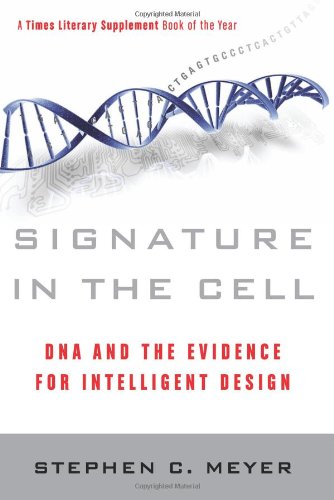
Signature in the Cell: DNA and the Evidence for Intelligent Design Review
Meyer (page 4) defines intelligent design: "The theory [intelligent design] does not challenge the idea of evolution defined as change over time or even common ancestry, but it does dispute the Darwinian idea that the cause of all biological change is wholly blind and undirected. Even so, the theory is not based on biblical doctrine. Intelligent design is an inference from scientific evidence, not a deduction from religious authority."
Meyer brings the broadest defense of intelligent design as science, pointing to many different arguments. Meyer points to the origin of genetic information (the so-called "DNA enigma"), and writes (page 27): "And if it was the case that evolutionary theory could not explain the origin of the first life because it could not explain the origin of the genetic information in DNA, then something that we take for granted was quite possibly an important clue in a mystery story." And this mystery story includes many arguments: starting with "specified information" or "functional information," relating these to the molecular foundation of life; and providing many philosophical arguments about what constitutes science. Meyer is very thorough and its is easy for the reader to get lost in this long book. Meyer looks at the Dover trial and demolishes the legal arguments made by Judge Jones.
Meyer makes the case for intelligent design, in my view, but he stops short with the causation that underwrites intelligent design. For Meyer, the only known cause for specified information has been human consciousness and agency, and therefore, intelligent causation offers the best available explanation for the origin of many features of life. This is well enough, but Meyer shirts the issue about the manifestation of this consciousness throughout life and in human expressions of consciousness. If we are as much the designing agency, are we only talking about an innate vitality that carries consciousness with it? Meyer is dismissive of vitalism, and ask (page 40) only two questions: "If organic chemicals could arise from inorganic chemicals, then why couldn't life arise in the same way? After all, if vitalism was wrong as it now appeared, then what is life but a combination of chemical compounds?"
We should not confuse vitalism with a rigid dualism that sees a strict separation between organic and inorganic chemicals. We must look for the source of vitality in the very laws of chemistry, and of physics, and track this source back to the fabric of space-time.
Imagine that we are set out to explore a strange new world, sitting inside a special vehicle that has electronic devices for sending and receiving information between the inside (where we sit) and outside world. This information comes to us by the synthesis of sending and receiving; the vehicle so signified. After years of exploring, we come to an astonishing conclusion about the outside world: its space-time fabrics permits the synthesis of sending and receiving at the most fundamental level; the outside looks strangely like the inside; and no matter how much we travel to the outside we always return to the inside of our special vehicle where we can take off in a new direction again. I have just described a designing consciousness that is consistent with intelligent design. And while we may look to the outside, we never get beyond the blunt roadblock given by the synthesis of sending and receiving where we see ourselves sitting safely in the vehicle that strangely carries the capacity to acquire foresight and make designs that are necessary for our survival.
We sometimes think that consciousness is so much more than life, but according to intelligent design life also arranged itself through the designing consciousness. Therefore, mind is confounded with the life force behind the synthesis of sending and receiving. The vehicle that explores the world need only follow a universal grammar that permits self-cultivation, starting with the most primitive spark of consciousness given to us by mere feelings. Intelligent design transforms into vitalism, and the universal grammar is as much the Tao Te Ching that engages our emotions. Reason is found married to its emotion, consciousness is now non-dual, and the self is no where to be found except it sits safely in the vehicle.
I believe "Signature in the Cell" offers compelling arguments to justify my above interpretation. Intelligent design need not be about a white haired designer that is held separate from his creation in a biblical sense, and intelligent design may contradict the many assertions coming from creationism. A designer that is outside space and time (sitting in vehicle) is not a designer that is held separate from deep reality. Space and time make only an observed surface manifold, leaving unobserved most of what makes up the four dimensions of space and time.
And what of the DNA enigma, and this vehicle that makes functional information by the activity of sending and receiving? We would expect DNA to be highly self-regulated, coming in modules, coming with a context dependency that points to beyond DNA to cellular structures.
Meyer (page 460) writes: "As molecular biology and genomics have revealed new features of the cell's information storage and processing system, they have inspired a new conception of the gene - one in which the gene is no longer understood as a singular, linear, and localized entity on a DNA strand, but rather one in which the gene is understood as a distributive set of data files available for retrieval and context-dependent expression by a complex information-processing system."
Meyer (page 476) writes: "Thus, in each new generation, the form and structure of the cell arise as the result of both gene products and preexisting three-dimensional structure and organization. Cellular structures are built from proteins, but proteins find their way to correct locations in part because of preexisting three-dimensional patterns and organization inherent in cellular structures. Preexisting three-dimensional form present in the preceding generation (whether inherent in the cell membrane, the centrosomes, the cytoskeleton, or other features of the fertilized egg) contributes to the production of form in the next generation. Neither structural proteins alone nor the genes that code for them are sufficient to determine the three-dimensional shape and structure of the entities they form. Gene products provide necessary but not sufficient information for the development of three-dimensional structure within cells, organs, and body plans."
Signature in the Cell: DNA and the Evidence for Intelligent Design Feature
- ISBN13: 9780061472794
- Condition: New
- Notes: BUY WITH CONFIDENCE, Over one million books sold! 98% Positive feedback. Compare our books, prices and service to the competition. 100% Satisfaction Guaranteed
Signature in the Cell: DNA and the Evidence for Intelligent Design Overview
A Compelling Case for Intelligent Design Based on Revolutionary Discoveries in Science
In Signature in the Cell, Stephen Meyer has written the first comprehensive DNA-based argument for intelligent design. As he tells the story of successive attempts to unravel a mystery that Charles Darwin did not address—how did life begin?—Meyer develops the case for this often-misunderstood theory using the same scientific method that Darwin himself pioneered. Offering a fresh perspective on one of the enduring mysteries of modern biology, Meyer convincingly reveals that the argument for intelligent design is not based on ignorance or "giving up on science," but instead on compelling, and mounting, scientific evidence.
Available at Amazon Check Price Now!
Related Products
- The Cell's Design: How Chemistry Reveals the Creator's Artistry
- Darwin's Dilemma
- The Edge of Evolution: The Search for the Limits of Darwinism
- The Devil's Delusion: Atheism and its Scientific Pretensions
- Darwin's Black Box: The Biochemical Challenge to Evolution
Customer Reviews
Getting Smart - K. Cole - ORANGE COUNTY
This book should be in every school in America, it would change our entire nation. There is evidence of intelligent design and it is absolutely being suppressed. I challenge anyone who is truly seeking truth to read this book.
Intellectual Integrity - Mikhail Panankovich - Seattle
Mr. Meyer presents a very cohesive arguement for how Intelligent Design explains the "chicken or the egg" riddle of self replicating RNA molecules and how Neo-Darwinsm fails. I've read a number of negative "reviews" on this book and from their comments can only conclude that the reviewers performed "dry lab" analysis of Meyers' work. What I appreciate about Charles Darwin and Stephen Meyers is their unruffled intellectual integrity. Both Darwin and Meyers, as men of science, understand that science is the eandless process of sifting possiblities for facts by using the principles of scientific method. Meyers follows these principles flawlessly.
Regardless of what side you take in the highly politicized and entrenched Creation vs. Evolution debate, those who are still rational enough to follow the evidence where ever it leads owe it to themselves to give Signature in the Cell a thorough read. This book is not light reading for the biology novice, Mr. Meyers does only a fair to poor job at making the highly technical aspects accessible to the average reader. Had Meyers done a better job of brining it to the masses I would have offered a 5 star review. While he presents an outstanding case, many will miss out on his work an continue to beleive that Evolution has all the answers, when in fact Neo-Darwinism provides many more questions than answers.
More confidence in our Creator - Scott -
The further I read on the subject of DNA and protein synthesis the more confidence I have in the scientific evidence for a Creator. Signature in the Cell does not direct the reader to who that Creator is. It also does not make the discussion a religious issue or choice. I most certainly believe that I know the answer to that question. But it is irrelevant to the scientific investigation that the book presents. Certainly, an open minded person should be able to handle dealing with the facts as presented, whether they are a theist, deist, atheist or agnostic. Facts are facts. Evidence is evidence.
Dr. Meyer has done an excellent job explaining a difficult subject. He has done it so that non-scientists can understand the concepts given they have a basic understanding of DNA function.
*** Product Information and Prices Stored: Sep 03, 2010 10:40:05

No comments:
Post a Comment